Overcoming High Signal in your Immunoassay
In protein-based immunoassays, signal is everything—but only when it is accurate. While much of assay development focuses on improving sensitivity, excessive non-specific signal can be just as detrimental as insufficient signal. High signal often masks true assay performance, compresses dynamic range, and increases the risk of false positives, ultimately compromising clinical validity and reproducibility.
For assay developers working across ELISA and other immunoassay platforms, understanding the root causes of high signal—and implementing targeted strategies to control it—is essential to achieving optimal signal-to-noise ratios and robust assay performance.
Understanding High Signal: More Than Just “Too Much Color”
Immunoassays are built on the specificity of antigen-antibody interactions to quantify analytes with precision. However, elevated signal output does not always reflect true analyte presence. Instead, it is frequently driven by assay artifacts such as non-specific interactions, reagent imbalance, or suboptimal workflow conditions.
High signal can lead to:
- False positive results
- Poor standard curve resolution
- Reduced assay dynamic range
- Misinterpretation of low-concentration samples
In short, high signal reduces confidence in your assay—particularly in diagnostic applications where accuracy is critical.
Common Causes of High Signal in Immunoassays
Several key factors consistently contribute to elevated signal:
1. Non-Specific Binding (NSB)
Non-specific binding remains one of the most significant contributors to elevated background and signal distortion. When antibodies bind unintended targets or surfaces, signal increases independently of analyte concentration.
2. Inadequate Washing
Insufficient removal of unbound reagents allows excess conjugate or detection molecules to remain in the well, artificially increasing signal intensity.
3. Reagent Oversaturation
Excess detection antibody or enzyme conjugate can saturate the system, overwhelming the assay and elevating baseline signal.
4. Suboptimal Substrate Selection or Handling
Substrates with inherent background signal, or improper timing during signal development and stopping, can lead to signal amplification beyond intended levels.
5. Improper Reaction Timing
Failure to stop enzymatic reactions at the correct time allows continued signal development, resulting in inflated readouts.
6. Matrix Interference and Sample Quality
Endogenous factors such as heterophilic antibodies, rheumatoid factors, or sample contamination can drive non-specific signal increases.

Strategies to Overcome High Signal
Effectively reducing high signal requires a systematic approach that targets both assay design and reagent optimization. The following best practices are key to restoring assay balance:
Optimize Blocking and Stabilization
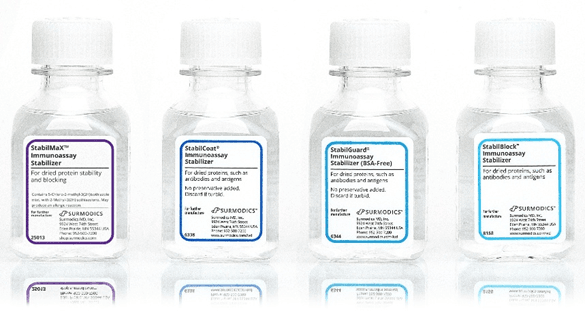
High-performance blocking reagents are essential for minimizing non-specific interactions. Effective blockers reduce background without suppressing true signal, enabling clearer differentiation between positive and negative samples.
Equally important, protein stabilizers preserve the structural integrity and functionality of assay components—ensuring consistent performance across runs and over time.
Improve Washing Efficiency
Robust washing protocols are critical for removing unbound materials. This includes:
- Validated wash buffer formulations
- Optimized wash cycles and volumes
- Proper calibration of automated or manual washing systems
Even small inconsistencies in washing can significantly impact signal levels.
Right-Size Reagent Concentrations
Careful titration of antibodies, conjugates, and detection reagents is essential. Oversaturation can quickly elevate signal beyond the assay’s useful range. Developers should:
- Perform systematic titration studies
- Evaluate signal-to-noise ratios across concentrations
- Avoid “more is better” assumptions
Select High-Quality Substrates
Substrate choice directly influences assay sensitivity and background. High-quality substrates with low intrinsic signal and consistent performance help maintain controlled signal development and reproducibility.
Control Reaction Kinetics
Timing is critical. Standardizing incubation and stopping steps ensures consistent signal generation across plates and runs. Rapid and complete stopping of the enzymatic reaction prevents continued signal drift.
Mitigate Matrix Effects
Sample variability is unavoidable—but its impact can be controlled. Specialized assay diluents can block interfering substances such as heterophilic antibodies while preserving true analyte signal, improving assay accuracy across diverse sample types.
The Role of Reagent Selection in Signal Control
Ultimately, overcoming high signal is not just about troubleshooting—it is about building robustness into the assay from the start.
At Surmodics IVD, we design reagents specifically to:
- Reduce non-specific binding
- Minimize matrix interference
- Stabilize proteins for long-term performance
- Deliver consistent, low-background signal
Our portfolio of blockers, stabilizers, diluents, and substrates is engineered to help assay developers achieve optimal signal-to-noise ratios without compromising sensitivity or specificity.
Final Thoughts
High signal is often a symptom of deeper assay design challenges—but it is also an opportunity. By systematically addressing the root causes and leveraging high-performance reagents, assay developers can transform noisy, unreliable systems into precise, reproducible diagnostic tools.
In today’s IVD landscape, where accuracy and consistency are non-negotiable, controlling signal is not optional—it is foundational.
If you are working to optimize your immunoassay performance, Surmodics IVD is here to support you with the expertise and reagents needed to overcome even the most persistent challenges.
Interested in optimizing your assay performance? Connect with our technical team or explore more resources in the Surmodics IVD Library.

